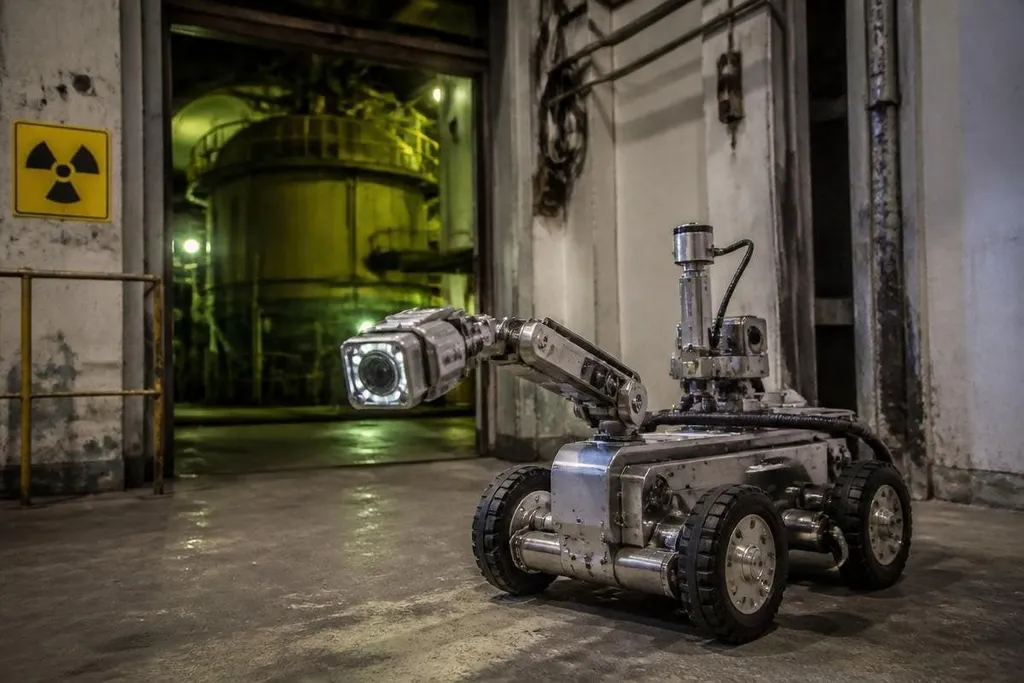
A robot can keep moving in a radioactive site while its cameras, memory, or motor controls slowly fail. Survival depends on the radiation type, the total dose, and how long the robot must work near the source.
This matters for engineers choosing an inspection or cleanup robot. A machine that works in a normal factory may stop after a short run in a reactor building or space environment.
Quick read
- Total dose matters as much as dose rate. A low rate over many hours can still damage electronics.
- Shielding protects some parts, but it adds weight and can block sensors or motion.
- A radiation test report matters more than the phrase “radiation hardened.”
What radiation does to a robot
Ionizing radiation can change materials and damage electronic circuits. It may cause a temporary error, flip a memory bit, degrade a sensor, or destroy a component after enough exposure.
The type of failure depends on the source and the part. A camera may lose image quality, while a computer may restart after a memory error. Motors and gearboxes can keep working while the control board has already failed.
Total ionizing dose is the accumulated energy absorbed by a material. Dose rate describes how quickly that exposure arrives. Engineers need both figures because a robot may face a short, intense event or a lower level during a long inspection.
Neutrons and heavy particles create a different problem. They can disturb semiconductor materials and cause single-event effects, where one particle changes a stored bit or triggers a fault. Spacecraft designers deal with this risk, and nuclear sites can have their own mix of radiation.
Shielding starts with the mission
Metal shielding can reduce the radiation reaching a circuit, but no material blocks every type equally well. Dense materials help with some sources, while other radiation needs a different design or more distance.
The robot's layout matters as much as the material. Engineers can place sensitive electronics behind a shield, move them away from the source, and run cameras through a replaceable housing.
A long cable may keep the computer outside the hot area, though the cable itself can become a failure point. Shielding also changes the robot. Extra mass raises the load on motors and joints.
A thick camera cover can narrow the field of view, and a sealed enclosure can trap heat. The design has to protect the circuit without making the robot too heavy, too hot, or too blind to do its job.
That trade-off is why radiation work needs mission details, not a generic label. The useful questions are where the robot will work, how close it gets, how long it stays, and which part must keep running.
Electronics need fault handling
Radiation-resistant parts can take more exposure before they fail, but they still have limits. A good design pairs those parts with software that checks memory, resets failed processes, and records faults for later review.
Redundant computers can compare results, while error-correcting memory can fix some changed bits. These features don't make a robot immune to radiation. They give the system a way to detect faults and keep a safe task running when one part misbehaves.
Heat makes the problem harder. Shielding can reduce radiation but slow heat flow, so the enclosure needs a path to shed heat. If the robot must stop, it should fail in a known state and keep its drive system from moving without control.
A radiation robot can stay within its dose limit and still fail when heat builds inside the enclosure. Use Robot24.com to compare the maker’s dose and temperature limits with the test setting and recovery plan before you ask what the robot can handle.
What a buyer should ask for
A vendor's test plan should match the site where you will use the robot. Ask for the test method, the dose, the dose rate, the radiation type, and the parts tested. A test on one circuit board doesn't prove that the full robot will keep working.
Use this checklist before approving a machine:
- Name the source: record whether the site has gamma rays, neutrons, heavy particles, or a mix.
- Set the exposure: define the dose rate and total dose for the full mission.
- Check the weak parts: ask how cameras, memory, batteries, cables, seals, and motor drives were tested.
- Review failure behavior: confirm what the robot does after a sensor fault, memory error, or lost link.
- Plan recovery: identify which parts can be replaced without sending a person into the area.
- Run a site trial: test the complete robot with its real tools, cables, shielding, and control software.
The last point matters because radiation performance can change once the robot carries a tool or works near a wall that reflects particles. A board tested alone tells you less than a complete machine tested in the same layout it will use on site.
The limit that still needs proof
Radiation-ready design is a chain. Shielding protects the parts, distance reduces exposure, fault handling keeps errors from spreading, and testing shows how long the chain holds.
I'd reject any purchase that gives a radiation rating without the test dose, radiation type, and failure record. Until those details are available, the robot may be suitable for a short inspection, but its working life in that site remains unproven.